
New · eBook · Instant download
Bihar: In the Crucible of Time
A History of the Unfinished Foundation, 1800–2026. From the Company’s survey of 1811–12 to the caste survey of 2023: what Bihar is, and why it is what it is.
By Niten Chandra, who spent his early life in Bihar, served there from 2002 to 2005, and was Law Secretary to the Government of India from 2022 to 2024.
Secure payment by Razorpay: UPI, cards, net banking · Download straight after payment
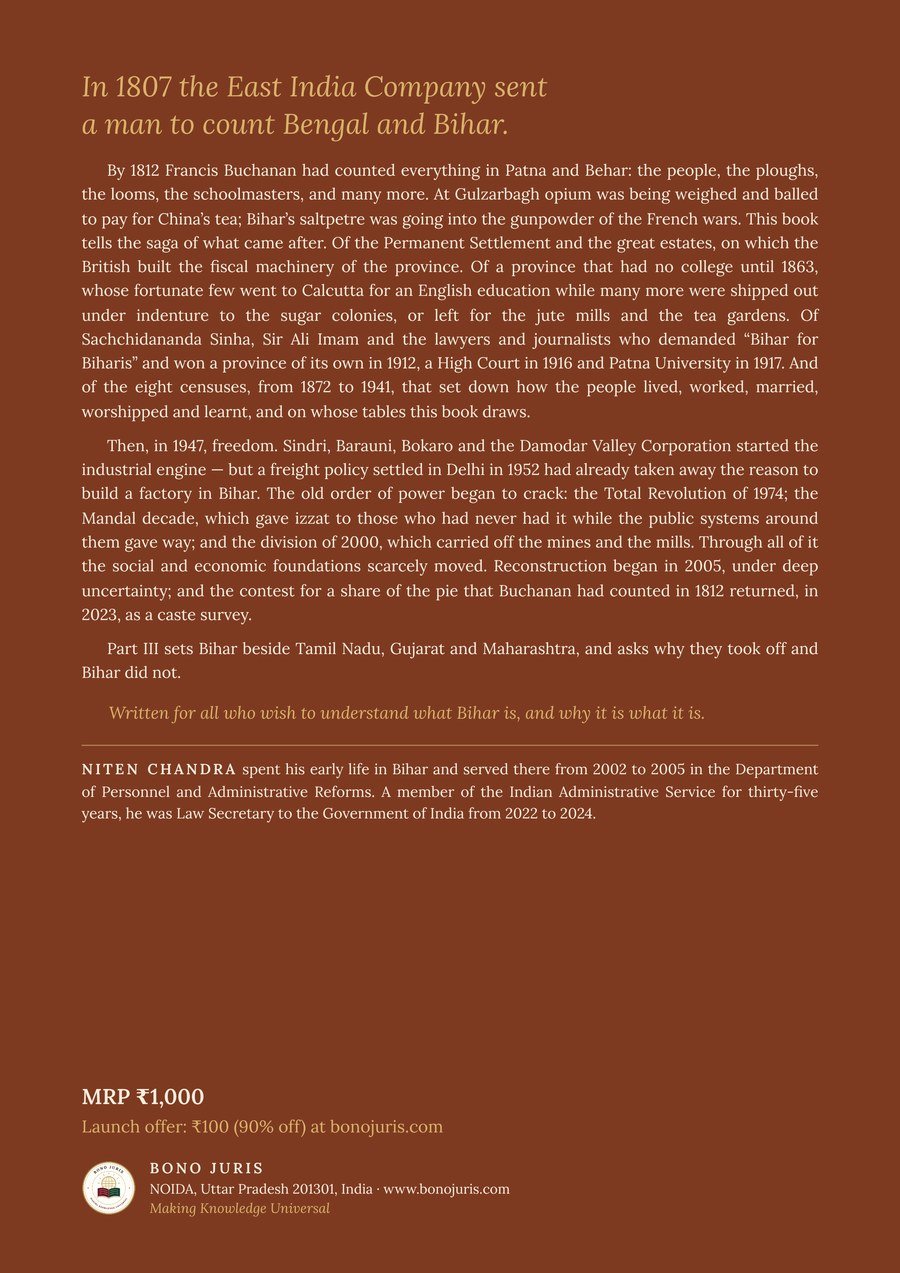

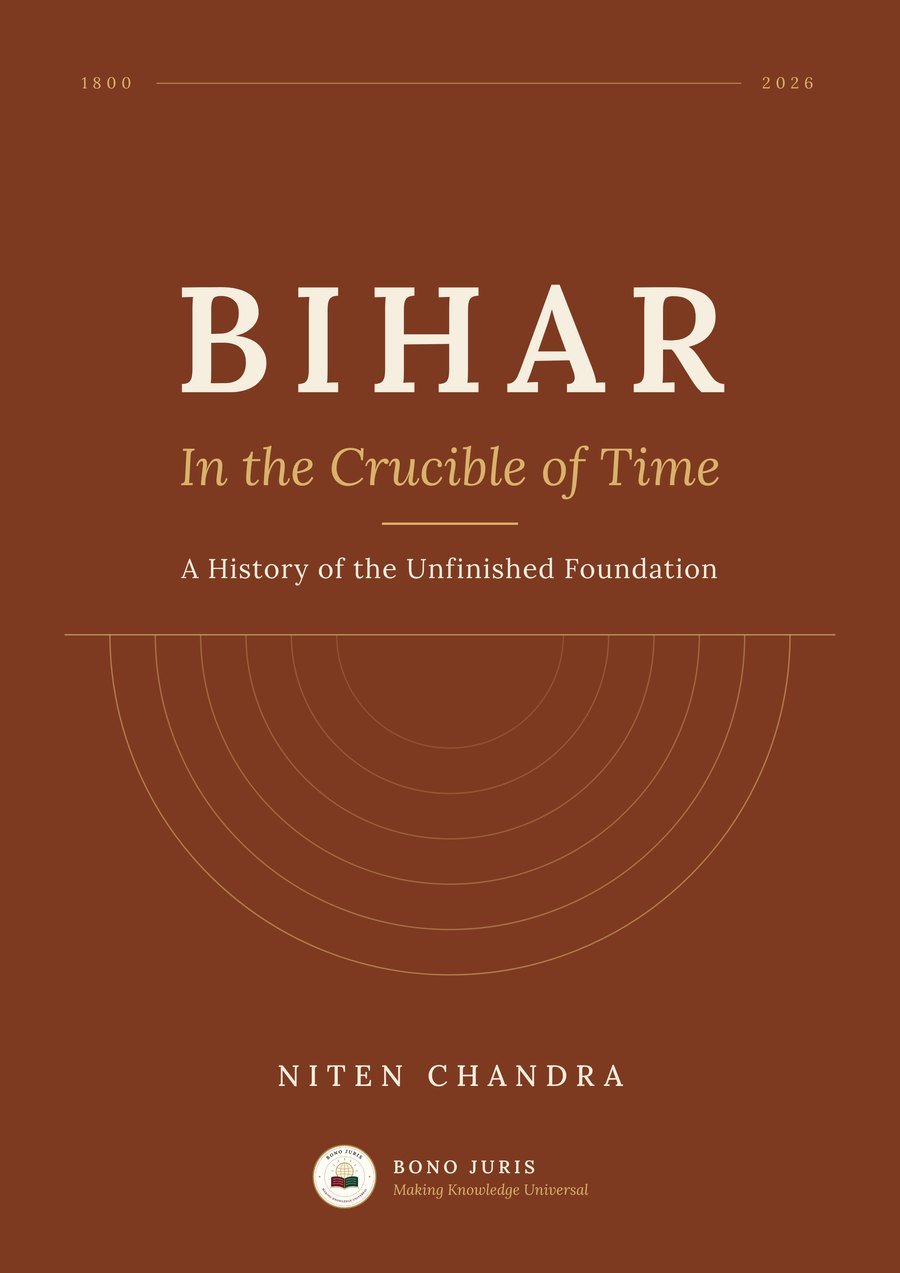
Hover over the book (or tap it on a phone) to stop it and read the cover.
In 1807 the East India Company sent a man to count Bengal and Bihar.
By 1812 Francis Buchanan had counted everything in Patna and Behar: the people, the ploughs, the looms, the schoolmasters, and the men who could write and had nothing to write for. At Gulzarbagh opium was being weighed and balled to pay for China’s tea; Bihar’s saltpetre was going into the gunpowder of the French wars. Two centuries on, his ledger still reads like a diagnosis.
This book tells what came after. Of the Permanent Settlement and the great estates — landlords in law, principalities in fact — on which the British built the fiscal machinery of the province. Of Kunwar Singh, eighty years old, raising his Bhojpuri clansmen against the Company in 1857. Of the famine of 1866 that devastated Tirhut, Champaran and Gaya. Of a province that had no college until 1863, whose fortunate few went to Calcutta for an English education while many more were shipped out under indenture to the sugar colonies, or left for the jute mills and the tea gardens. Of Sachchidananda Sinha, Sir Ali Imam and the lawyers and journalists who demanded “Bihar for Biharis” and won a province of its own in 1912, a High Court in 1916 and Patna University in 1917. Of Gandhi walking into the indigo country of Champaran in 1917. Of the First World War, which briefly revived the handloom, and the two decades after it, which broke the artisan castes. Of the Depression that crashed grain prices and drove tenants off their land, and of Swami Sahajanand Saraswati, who answered at the Sonepur fair in November 1929 with the Kisan Sabha. Of the earthquake that destroyed Munger, Darbhanga and Muzaffarpur in 1934; of seven students shot dead at the Patna Secretariat in August 1942; and of a Second World War in which the collieries of Jharia and the steel of Jamshedpur ran round the clock. And of the eight censuses, from 1872 to 1941, that set down how the people lived, worked, married, worshipped and learnt, and on whose tables this book draws.
Then, in 1947, freedom. Sindri, Barauni, Bokaro and the Damodar Valley Corporation started the industrial engine — but a freight policy settled in Delhi in 1952 had already taken away the reason to build a factory in Bihar. The old order of power began to crack: the Total Revolution of 1974; the Mandal decade, which gave izzat to those who had never had it while the public systems around them gave way; and the division of 2000, which carried off the mines and the mills. Through all of it the social and economic foundations scarcely moved. Reconstruction began in 2005, under deep uncertainty; and the contest for a share of the pie that Buchanan had counted in 1812 returned, in 2023, as a caste survey.
Part III sets Bihar beside Tamil Nadu, Gujarat and Maharashtra, and asks why they took off and Bihar did not.
Written for all who wish to understand what Bihar is, and why it is what it is.
What you will find
Buchanan’s survey, read again
The Prologue rebuilds the Company’s count of Patna and Behar in 1811–12 from Buchanan’s own tables: land, people, crops, trades, schools and the men fit to act as writers.
Eight censuses, one province
From 1872 to 1941 the census set down work, literacy, marriage and community in Bihar. Part I reads those tables and says where they will not bear the weight.
From abolition to the caste survey
Part II follows Bihar from zamindari abolition and freight equalisation through the Total Revolution, Mandal and the division of 2000 to the reconstruction and the survey of 2023.
Three States beside Bihar
Part III measures Bihar against Tamil Nadu, Gujarat and Maharashtra on the same official series, from 1947 to 2026, and asks what separated them.
Every table and figure carries its source. The Index runs to more than six hundred headings.
Contents
Part I
Bihar, 1800–1947
- Prologue · The Survey: What the Company Ordered Counted, and What Buchanan Found, 1811–12
- Chapter I · The Company’s Province: Bihar on the Eve
- Chapter II · Law Before the Codes: Three Legal Universes
- Chapter III · Property, Contract and the Bonded Body
- Chapter IV · The Five Rajas: Landlords in Law, Principalities in Fact
- Chapter V · A Hundred and Fifty Years: A Passage by Decades
- Chapter VI · Water, Power and the Unbridged River
- Chapter VII · The Texture of Living
- Chapter VIII · The Enumerated Province: Bihar and the Colonial Censuses, 1872–1941
- Chapter IX · What the Enumeration Found: Work
- Chapter X · The Second and Third Ladders: Letters and Marriage
- Chapter XI · The Communities One by One, and the Limits of the Tables
- Chapter XII · The Largest Minority: Bihar’s Muslims in the Census, 1872–1941
- Chapter XIII · Letters: What Bihar Was Taught, and Who Taught It
- Chapter XIV · The Third and Fourth Soundings, 1879 and 1917
- Chapter XV · The Making of New Elites
- Chapter XVI · The Province Separated: 1912, and What a Capital Was Worth
- Chapter XVII · Scripture into Statute: The Smritis in Bihar
- Chapter XVIII · The Grammar of Caste
- Chapter XIX · The Red Thread: Communism in the Countryside
- Chapter XX · Seasons of Blood
- Chapter XXI · The Ledger of a Century and a Half: 1811 against 1947
- Conclusion · The Four Tests: What Was Planned, and What Was Done Instead
Part II
Bihar, 1947–2026
- Chapter I · The Inheritance: Abolition, Heavy Industry and Freight Equalisation
- Chapter II · The Fracture: Instability, Total Revolution, and the Karpoori Formula
- Chapter III · Izzat and Entropy: The Mandal Decade
- Chapter IV · Sushasan: The Reconstruction, 2005–2026
- Chapter V · The Long War in the Fields
- Chapter VI · The Ledger of Three Phases
- Chapter VII · What Bihar Makes
- Chapter VIII · Bridges, Light and Water
- Chapter IX · The Remittance Republic
- Chapter X · The Election: Machinery, Money, Society and Power
- Chapter XI · Counting Caste: Enumeration, the Commissions and the Survey of 2023
- Chapter XII · Difficulty, Not Caste: What Article 340 Asked and Who the Census Already Counts
- Chapter XIII · Adequate, Not Proportional
- Chapter XIV · The Conundrum Resolved: Identifying a Backward Class
- Conclusion · The Arithmetic of Dignity
Part III
Three Transformations
- Chapter I · Tamil Nadu: The Dravidian Wager
- Chapter II · Gujarat: The Merchant’s Republic
- Chapter III · Maharashtra: The Cooperative and the Metropolis
- Chapter IV · All Things Considered: The Four States Compared
- Conclusion · What the Contrast Teaches
Epilogue and Tributes
After the Parts
- Epilogue · The Arithmetic of the Remedy
- A Tribute · Jan Nayak
- A Tribute · Lok Nayak
PDF eBook · 695 pages
Bihar: In the Crucible of Time, 1800–2026
PDF · download on the next page after payment
Launch price until 19 February 2027, then ₹1,000. Prices include applicable taxes.
Payments are processed securely by Razorpay in the name of our proprietor, Niten Chandra. This name will appear on your bank or UPI statement.

Our vision: Making Knowledge Universal

About the author
Niten Chandra spent his early life in Bihar, where he lived until 1982, and served in Bihar from 2002 to 2005 in the Department of Personnel and Administrative Reforms, Government of Bihar. A member of the Indian Administrative Service for thirty-five years until 2025, he was Law Secretary to the Government of India from 2022 to 2024 and Secretary to the High Level Committee on Simultaneous Elections, and sat ex officio on the Law Commission of India, the India International Arbitration Centre and the Executive Committee of the Indian Law Institute. Trained in economics, he is co-author, with Shalini Chandra, of Competition Law and Policy and Administrative Law.
Written for
All who wish to understand what Bihar is, and why it is what it is.
Read before you buy
Free: the opening pages, the full Contents and Lists, and the first pages of the Prologue and of Chapters I and II. No sign-up.
Free sample (PDF)Questions
How do I get the book?
Press “Get the eBook”, pay on the secure Razorpay page, and you are taken straight to a page with your download button. Nothing is sent by email.
When do I download it?
Straight after payment, on the next page. Press Download once and save the PDF to your phone, tablet or computer. If the download fails, write to welcome@bonojuris.com with your Razorpay payment ID.
How do I pay?
UPI (Google Pay, PhonePe, Paytm and others), debit and credit cards, or net banking, through Razorpay. We never see your card or bank details. Razorpay emails you a payment receipt.
Is this a printed book?
No. What you buy here is the complete PDF eBook, with bookmarks for every Part and chapter.
What period does it cover?
From the Company’s survey of 1811–12 to 2026, with the survey of 2023 and the latest official series.
Can I share the file?
No. The eBook is licensed for your personal use only, and every page says so.
Refunds?
A downloaded eBook cannot be returned. We refund in full if you were charged twice or could not download the book and we could not fix it. See the Refund Policy.